
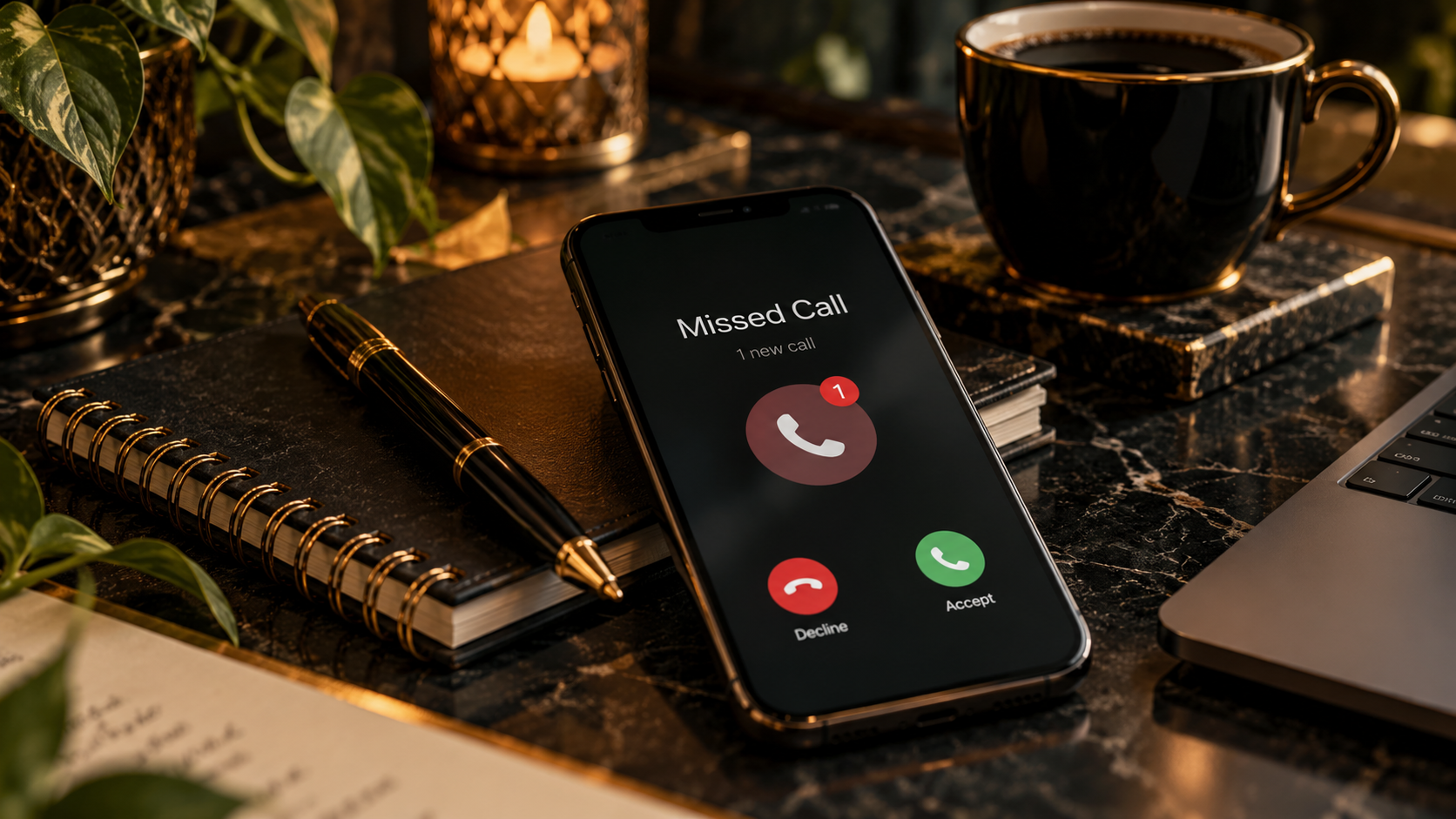
How missed calls quietly cost businesses revenue, and what you can do about it.
Your phone rings. You’re helping a customer, meeting with a client, or handling something that simply cannot wait.
The call goes unanswered.
It seems harmless. After all, you can always call them back.
But here’s the question: Will that potential customer still be available when you do?
For service-based businesses, a missed call isn’t always just a missed conversation. Sometimes, it’s a missed appointment, an unbooked consultation, or a customer who chooses someone else.
The Revenue You Never See
Most business owners know how much revenue they generate each month. Far fewer know how much potential revenue disappears before a customer ever books.
Consider a hypothetical example.
A business misses 20 calls each month. Suppose 25% of those callers would have become customers, with an average first transaction worth $200.
That’s potentially:
- 20 missed calls
- 5 missed customers
- $1,000 in missed monthly revenue
- $12,000 in potential annual revenue
These numbers are illustrative, not a prediction. Not every missed caller is a qualified lead, and not every lead becomes a paying customer.
But even a modest number of lost opportunities can add up.
And the first transaction may be only part of the picture. Some customers return for additional appointments, refer friends, or become long-term clients.
Why Voicemail Isn’t Always Enough
Voicemail still has its place, but it depends on the caller being willing to leave a message.
Some people will. Others may hang up and try another business.
This is particularly relevant for appointment-driven industries, including salons, wellness practices, home services, and professional service providers.
When someone is ready to book, timing matters.
A business doesn’t necessarily need someone answering the phone every minute. It needs a reliable way to acknowledge an inquiry and make the next step easy.
A Smarter Way to Handle Missed Calls
One option is an automated missed-call text-back system.
When an eligible call goes unanswered, the system can send a text message such as:
“Thanks for calling! We’re sorry we missed you. How can we help?”
That simple acknowledgment creates an opportunity to continue the conversation.
Depending on how the system is configured, the business may also be able to:
- Direct callers to an online booking page.
- Collect basic information about their inquiry.
- Notify the appropriate team member.
- Organize the conversation in one place.
- Follow up when a response is needed.
Automated messaging should be configured with appropriate consent, privacy, and messaging compliance safeguards.
The goal isn’t to replace personal service. It’s to make sure a busy moment doesn’t automatically become a lost opportunity.
The Bigger Problem: Disconnected Systems
Missed calls are often a symptom of a larger operational challenge.
A business might have a website, a phone number, a booking calendar, an email inbox, and several employees managing customer conversations.
But if those pieces don’t communicate, opportunities can slip through the cracks.
Someone submits a contact form but never receives a response.
A potential customer asks about availability but doesn’t get a booking link.
A consultation is scheduled, but the reminder never arrives.
Individually, these moments seem small. Together, they create unnecessary friction for both customers and business owners.
What a Connected Business Looks Like
Imagine a more organized experience.
A potential customer discovers your website and reaches out.
Their inquiry enters a central system. They receive an appropriate acknowledgment. Your team can see the conversation, respond, and help them schedule the next step.
After booking, reminders help everyone stay informed.
Instead of relying entirely on memory, sticky notes, or scattered messages, your business has a repeatable process.
That’s what thoughtful business automation should accomplish.
Not more technology for its own sake.
Less friction. Better follow-through. More room to focus on the work you do best.
Start by Measuring What’s Happening
Before investing in new tools, look at how your business currently handles incoming inquiries.
Ask yourself:
- How many calls do we miss during a typical week?
- How quickly do we respond to new inquiries?
- Can customers book an appointment without waiting for a callback?
- Do we have a reliable follow-up process?
- Can we tell which inquiries eventually become customers?
The answers can reveal where your business is losing time and where better systems could make a meaningful difference.
Your Business Shouldn’t Have to Choose Between Serving Customers and Finding New Ones
At Lucora Systems, we believe technology should support the human side of business, not complicate it.
We design bespoke websites and connected business systems that help businesses capture inquiries, streamline booking, and create more consistent follow-up.
Because great service shouldn’t begin only when someone finally gets through on the phone.
Ready to make your business more connected?